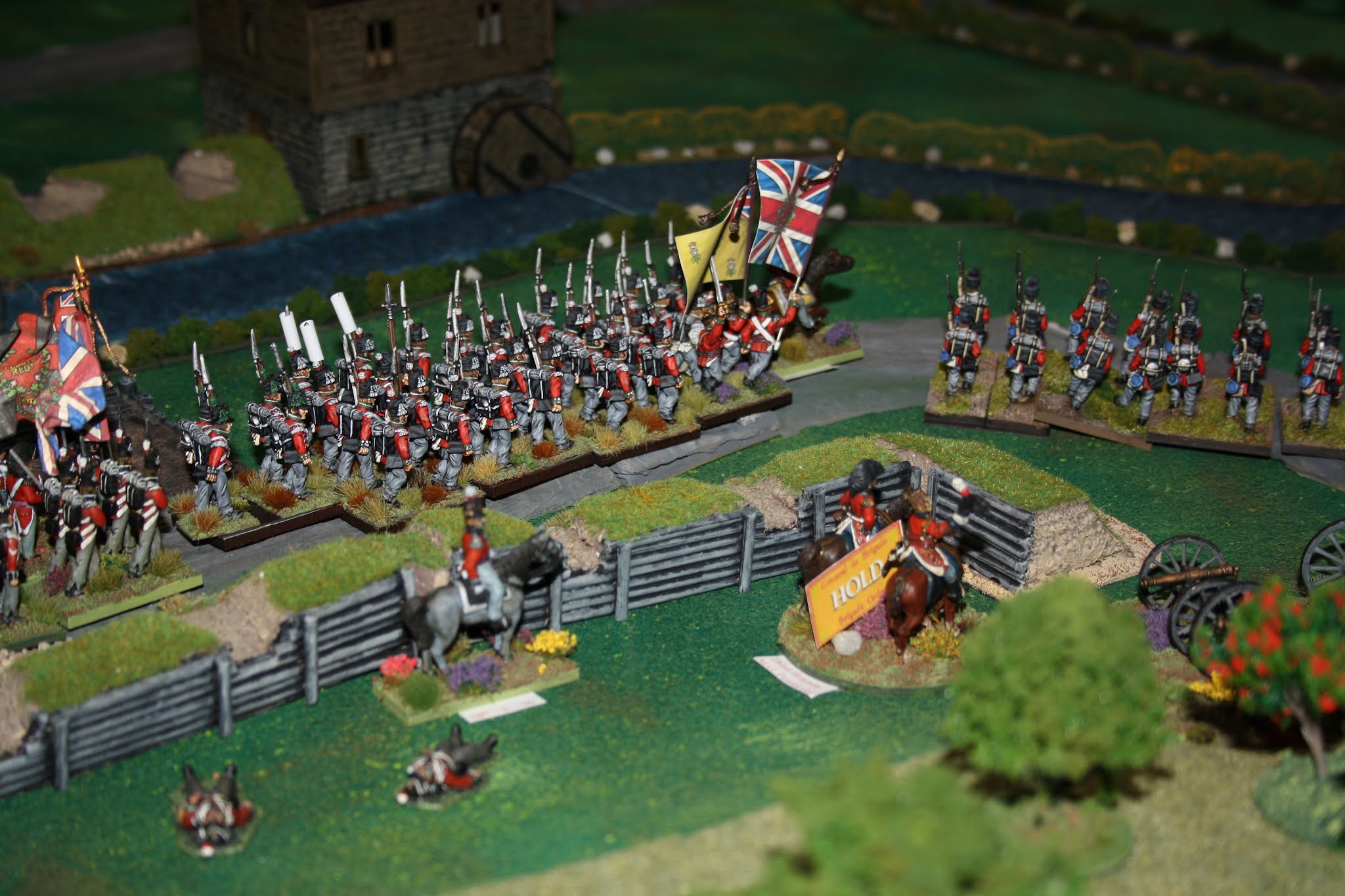
Finally after a year of no gaming we four double vaccinated gamers got together at Chez Rod's for a day of gaming and camaraderie. So, there was Rod, Paul, Bruce and Eric but unfortunately Howard could not make because of a family' commitment. As per normal games the rules are General de Brigade with an ever growing War of 1812 Addendum and a 20:1 ratio of figures. For a complete historical background, maps, orders of battle research please consult my previous entry at:
The following orders of battles are taken from my research (link above). Note that there are minor changes to the British OOB based on changes of up to three units that were allowed under the options of the Scenario.
Game British Order of Battle
|
The Battle of Plattsburg British Order of Battle and Strength (adjusted
for game on 30 July 2021) Commanding Officer – Lt-Gen. Prevost (P) [5] Commanding Officer Left Division– Maj Gen De
Watteville (A) Quarter-Master General Maj Gen Sir Sydney Beckwith –
Chief Engineer: LCol Hughes Chief Artillery: Maj. Sinclair – Commissariat: LCol. W. Robinson |
|||||
|
Brigade |
Regiment |
V.P. |
M + F |
Str |
Details |
|
1st Light Brigade – Major-General F.P. Robinson
(E)[1] |
|||||
|
Lt Coys |
27th, 76th
|
1 |
E |
8 |
(Sk) |
|
1/39th Foot |
Dorsetshire |
3 |
V |
36 |
|
|
1/88th Foot |
Connaught Rangers |
3 |
E |
40 |
|
|
1st Bde Art |
Maj W. Gordon |
3 |
E |
3 |
2 x 6pdr 1H |
|
|
|
|
|
|
|
|
2nd Brigade – Major-General T. Brisbane (E)[1] |
|||||
|
1/3rd Foot |
East Kent The Buffs |
3 |
E |
40 |
|
|
2/8th Foot |
King’s |
3 |
E |
28 |
|
|
13th Foot |
Somersetshire |
3 |
L |
32 |
|
|
49th Foot |
Hertfordshire |
3 |
V |
32 |
|
|
De Meuron |
Swiss in British Service |
3 |
V |
40 |
|
|
Voltigeurs |
Canadian Voltigeurs |
3 |
L |
20 |
Sk |
|
Indians |
Mohawks (attached to Volt.) |
3 |
L |
15 |
Sk |
|
Chasseurs |
Canadian Chasseurs |
3 |
L |
24 |
Sk |
|
2nd Bde Art |
Capt. W. Green |
3 |
E |
3 |
2 x 6pdr 1H |
|
Cavalry |
19th Light
Dragoons. |
3 |
E |
14 |
|
|
R.S.&M. |
Sapper companies |
1 |
V |
9 |
|
|
|
|
|
|
|
|
|
3rd Brigade - Major-General
M. Power (A)[1] |
|||||
|
1/5th Foot |
Northumberland |
3 |
V |
44 |
|
|
1/27th Foot |
Inniskilling |
3 |
V |
48 |
|
|
1/58th Foot |
Rutlandshire |
3 |
L |
36 |
|
|
3rd Bde Art |
Capt. H. Jackson |
3 |
E |
3 |
2 x 6pdr 1H |
|
Division Assets – Maj
Sinclair (A)[1] |
|||||
|
Artillery |
24 pdr Field guns |
1 |
E |
1 |
|
|
|
24 pdr Carronade |
1 |
E |
|
|
|
|
8” Heavy Howitzer, |
1 |
E |
1 |
|
|
Rockets |
RMA Rocket Battery (H) |
1 |
E |
1 |
|
|
R.E. |
Pioneer Company |
1 |
V |
4 |
|
|
Wagons |
Wagons carrying scaling
ladders |
1 |
V |
2 |
Each wagon carries enough
ladders for eight companies |
|
|
|
|
|
|
|
|
|
|
|
|
|
|
|
Augmentation |
Scenario dependent: Option
A: 8” mortar and 12 pdr gun in position, roll d6 for 18 pdr gun, Option B: d6
for 8” mortar and 12 pdr gun and 18pdr gun. |
||||
|
Artillery |
8” Mortar |
0 |
V |
1 |
|
|
|
12 pdr field gun |
0 |
V |
1 |
|
|
|
18 pdr field gun |
0 |
V |
1 |
|
Game American Order of Battle
|
The Battle of
Plattsburg – American Order of Battle Commanding Officer – Brig Gen Macomb (A) [5] Engineer:
Major Totten |
||||||
|
Brigade |
Regiment |
V.P. |
Morale |
Fir. |
Str. |
Details |
|
Fort Moreau - Col M.
Smith (A)
1 |
||||||
|
Artillery |
24 pdr. garrison guns (5gunners) |
2 |
V |
V |
2 |
|
|
Artillery |
18 pdr. Naval gun (5
gunners) |
1 |
V |
V |
1 |
|
|
Artillery |
18 pdr. Field guns (5
gunners) |
3 |
V |
V |
3 |
|
|
Infantry |
6th Infantry
Regt. |
3 |
L |
L |
16 |
|
|
Infantry |
29th Infantry
Regt. |
3 |
L |
L |
16 |
|
|
|
||||||
|
Fort Scott - Major Thomas Vinson (A)
1 |
||||||
|
Artillery |
Corps of Artillery --- 6
pdr. field guns |
3 |
V |
V |
3 |
|
|
Infantry |
33rd Infantry
Regt. |
3 |
L |
L |
16 |
|
|
Infantry |
34th Infantry
Regt. |
3 |
L |
L |
16 |
|
|
|
||||||
|
Fort
Brown - LCol Storrs (A) 1 |
||||||
|
Corps of Artillery --- 6 pdr. field guns |
3 |
V |
V |
3 |
|
|
|
Infantry |
30th Infantry
Regt. |
3 |
L |
L |
16 |
|
|
Infantry |
31st Infantry Regt. |
3 |
L |
L |
16 |
|
|
|
||||||
|
Lower Lake Area Major
Sprowl (A)
1 (area includes block houses near the lower and upper bridges
and the river/lake) |
||||||
|
Artillery |
Light Artillery --- 6 pdr. field guns |
3 |
V |
V |
3 |
Capt. Leonard |
|
Infantry |
1st Rifles - 1
Coy, |
1 |
E |
E |
4 |
LCol D. Appling |
|
Infantry |
29th Inf. - 1
Coy |
1 |
L |
L |
4 |
|
|
Infantry |
13th Inf. |
3 |
L |
L |
12 |
|
|
Cavalry |
Light Dragoons |
1 |
V |
V |
4 |
|
|
Pioneers |
1 Company |
1 |
V |
V |
6 |
|
|
N.Y. Militia |
Aiken’s
Rifle Coy -Plattsburg Militia |
1 |
C |
C |
4 |
|
|
1 |
C |
C |
4 |
|
||
|
N.Y. Militia |
Capt. Sherry’s Coy |
1 |
C |
C |
4 |
|
|
Vermont Militia |
1 |
C |
C |
4 |
|
|
|
|
|
|
|
|
|
|
|
Brigade |
Regiment |
VP |
Morale |
Fir |
Str. |
Details |
|
New York Militia Brigade Major-General Benjamin Mooers
(A) 1 |
||||||
|
Militia |
9th N.Y. Inf
& Sandford’s Ind Battalion |
3 |
C |
2L |
20 |
|
|
Militia |
36th & 37th
Inf |
3 |
C |
C |
20 |
|
|
Vol. Cavalry |
7th N.Y.
Dragoons |
1 |
2L |
x |
4 |
|
|
|
|
|
|
|
|
|
|
|
||||||
|
Vermont
Militia Brigade – Major-General Samuel P. Strong (A) 1 Not available to the American Player
Re British Scenario Option 3 A |
||||||
|
Militia |
1st Regiment 11
companies |
4 |
C |
C |
48 |
May be divided into two battalions. |
|
|
|
|
|
|
|
|
|
Militia |
2nd Regiment ---6 companies |
3 |
C |
C |
28 |
|
|
Militia |
3rd Regiment ---5
companies |
3 |
C |
C |
24 |
|
|
Militia |
4th Regiment ---5 companies |
3 |
C |
C |
24 |
|
|
Vermont
Volunteer Artillery 4pdr field guns |
3 |
2L |
2L |
3 |
|
|
|
|
|
|
|
|
|
|
Battle of Plattsburg Game Map.

Battle
of Plattsburg -British Scenario Objective, Options and Restraints:
2.
Situation. British/Canadian troops have arrived
and set up defensive positions during the late evening and night. The American’s
have withdrawn their advance posts to southern side of the Saranac. The New
York militia in the face of the redcoat’s steady onslaught have retreated to
southern side of the river in disarray.
3.
The British commander has two operational options (One option must be declared to the GM at least two
days ahead the game start);
a.
Attack
immediately the following morning (after emplacements completed) and not
wait for Captain (N) Downie’s fleet arrival ETA approx.
one week –factors:
i.
No Vermont militia[i]
available to Macomb,
ii.
N.Y. militia brigade[ii] units
in RETREAT state,
iii.
Fort Moreau not complete --southern facing walls + abatis
line on south side of forts not installed, attackers can scale the fort’s walls
without ladders,
iv.
U.S.N. gunboats will assist Macomb in the absence of RN,
v.
One or two brigades may preposition at Pike’s Ford
(south side of river off board (thereby bypassing the bridges and accessing the
forts from the south) ATA determined by D6 roll as per timetable,
vi.
Roll 1d6 for possible arrival of 1 x 12 pdr (as per
time chart),
vii.
Roll 1d6 for possible arrival of 1 x 8” mortar (as per
time chart), and
viii.
Roll 1d6 for possible arrival of 1 x 18” gun (as per
time chart).
b.
Wait
approx. one week for the arrival the RN to destroy he USN fleet
–factors:
i.
RN gunboat support subject to RN victory,
ii.
If RN loses battle there will be no RN or USN gunboat
support,
iii.
Fort Moreau completed and abatis and ditch protecting
southern approach in place. Attackers will need ladders to scale the abatis and
trench,
iv.
N.Y. militia brigade in good morale state,
v.
The Vermont brigade will be available to Macomb,
vi.
One or two brigades may preposition at Pike’s Ford
(south side of river off board (thereby bypassing the bridges and accessing the
forts from the south), ATA determined by D6 roll as per timetable,
vii.
1 x 12 pdr and 1 x 8” heavy mortar in position before
start, and
viii.
18 pdr gun from Chazy landing in position before start.
4.
The British commander may construct an additional
brigade artillery emplacement if the parent brigade remains in the Saranac area
(E.G., if only one brigade proceeds to Pike’s Ford vice the max two, then the
remaining brigade’s artillery may man the additional emplacement. Also, he may
re-arrange any emplacements for his artillery (on game day morning before the start).
a.
the town north of the Saranac River is deserted,
b.
the Saranac River is not fordable (except for Pike’s Ford
off board),
c.
the Americans are located on the opposite (south) side
of the river,
d.
it is likely that the Americans will remove or have
removed bridge planking from the two bridges,
e.
the river is fordable at Pike’s Ford to the west (10 -16
turns away). The British may order one or more brigades to proceed in the hours
before dawn to arrive on the field as per the time chart (earliest ETA 05:50
two turns after game start latest ETA 0800 16 turns after game start).
6.
Double One:
If a unit rolls an unmodified double one (firing or melee) there is a risk to
its Colonel (use the Risk to General Table). If a battalion/regiment colonel is
killed, the figure is removed, and unit morale drops one level.
b. In
the case of hot successfully falling into to one of the forts or redoubts, roll
to see if the targeted gun is destroyed by fire (D6 -6).
c.
If the targeted gun is destroyed by fire, then roll to
see if the fire will spread to other guns. The D6 roll is the same as below.
9.
Indirect Fire: mortars and howitzers may be
placed behind cover e.g. hill or building and fire at targets with the aid of a
spotter who is an artillery officer. The spotting officer must be positioned no
further than 12” from the howitzer or mortar that he is ranging for.
10. Grouping
Howitzers: the howitzers from two brigades (in exchange for two six
pounders) may be added to form a three-gun howitzer battery. This must be declared to the GM
at least two days ahead the game start.
11. The
British Commander may reorganize his OOB by repositioning up to three units to
any formation he chooses. This
must be declared to the GM at least two days ahead the game start.
12. Specific
addendum rule considerations:
- The militia fire table
will not be used ie use normal GdeB tables,
- The militia fear of
Indians morale rule is not enforced.
[i] Vermont Militia brigade of 1 Bn of
48 figures, 1Bn. of 28 figures, two Bns. of 20 figures each and 3 x 4pdr guns
from the Vermont Volunteer Artillery.
[ii] N.Y. Militia brigade of two
battalions 20 figures each and 4 figures of NY Volunteer Light Dragoons.
............................................................................................................
Battle of
Plattsburg: American Scenario Objective, Restraints and Options:
1.
Objective. The American objective is to prevent the
British from taking the forts and blockhouses on the Plattsburg peninsula.
2.
Situation: The British arrived last afternoon
and evening. During this period, they have constructed several revetments for
their guns. In a vain attempt to slow down the redcoat juggernaut, the New York
militia have retreated to the southern side of the river and are in disarray (one
infantry unit is in Retreat status the other two are Unformed; roll
for unit recovery in the morale phase).
3.
Intelligence. Commodore Macdonough advises you
that the British commander, Lt-Gen Prevost, may now wait (one week) until Commodore
Downey RN has completed his fitting out of HMS Confiance before engaging
his squadron, which is anchored and cabled in the bay ready for battle. Also,
you are advised by the N.Y. militia commander MGen. Mooers that the Vermont
militia Division will not arrive for at least four or five days.
4.
Topographical Considerations.
a.
the town north of the Saranac river is deserted,
b.
the Saranac river is not fordable (except for Pike’s
ford),
c.
the British are located on the opposite (north) side of
the river,
d.
you
have the option of removing bridge planking before the game start,
e.
the river is fordable at Pike’s Ford to the west (approximately
10 - 16 turns away).
5.
Constraints.
a.
No American troops may be placed on the north side of
the Saranac River before the game start.
b.
Guns within the forts may not be repositioned outside
the fort.
c.
At game start, guns within the forts may be manhandled
(prolonged) anywhere.
d.
Troops
and revetments outside the forts may repositioned anywhere on the peninsula
before the game start but must be completed before the British player finalizes
his placements.
e.
If the British decide to wait one week for Cmdre Downie’s
RN fleet to engage Cmdre McDonough’s USN Fleet:
i.
your troops will have time to complete the forts and
the abatis around the south side of the forts.
ii.
the Vermont troops arrive and may
be place anywhere south of the Saranac River.
iii.
The New York militia are recovered to a normal morale
state.
iv.
The New York militia may be place anywhere south of the
Saranac River.
v.
You may ask the Commodore for possible gunboat support
(could arrive after sunrise via D6 roll as per timeline.
f.
If the British decide to attack immediately:
i.
Fort Moreau’s southern wall is incomplete,
ii.
There is no abatis wall,
iii.
The New York militia brigade is in RETREAT and UNFORMED
status,
iv.
The Vermont militia brigade will not arrive in time for
the battle,
v.
You may ask the Commodore for possible gunboat support
(could arrive after sunrise via D6 roll as per timeline.
a. the
town north of the Saranac River is deserted,
b. the
Saranac River is not fordable (except for Pike’s Ford off board),
c. American
troops are located on the south side of the river,
d. the
American commander may remove bridge planking from the two bridges,
e. the
river is fordable at Pike’s Ford to the west (10 turns). The British may order
one or more brigades to proceed in the hours before dawn to arrive on the field
at varying possible (d6 roll) times IAW the time chart.
7.
Double One:
If a unit rolls an unmodified double one (firing or melee) there is a risk to
its Colonel (use Risk to General Table). If battalion/regiment colonel is
killed the figure is removed and unit morale drops one level.
b.
In the case of hot shot successfully falling into to
one of the forts or redoubts, roll to see if the targeted gun is destroyed by
fire (D6 -6).
c.
If the targeted gun is destroyed by fire, then roll to
see if the fire will spread to other guns. The D6 roll is the same as below.
9.
Batteries firing hot shot that roll an unmodified double
one risk an ammunition explosion. Roll a D6, 3, 4, 5 or 6 = the fire
is put out; 1 or 2 causes an explosion (roll a D6 for the number
of gun/crews destroyed in the battery or fort).
10. Hidden
Units. The Americans may designate up to two battalions to be hidden in the
units either side of the road from Pike’s Ford. Advise the GM of their exact position before the game
start.
11. Specific
addendum rule considerations:
a. The
militia fire table will not be used ie use normal GdeB tables,
b.
The militia fear of Indians morale rule is not
enforced.
Battle of Plattsburg September, 1814 Time Record Chart (for 31 Jul 2021 Game)
|
0530 Dawn Visibility 24” |
0810 12pdr Arrival D6
(5/6) |
1050 |
1340 |
|
0540 |
0820 8” M Arrival D6
(5/6) |
1100 |
1350 |
|
0550 British Bde Arrival D6 5
or 6* |
0830 18pdr Arrival D6 (5/6) |
1110 |
1400 |
|
0600 British Bde Arrival D6 5
or 6* |
0840 8” Mo Arrival D6
(5/6) |
1120 |
1410 |
|
0610 Morn Twilight V. 36” |
0850 12pdr Arrival D6
(5/6) |
1130 |
1420 |
|
0620 British Bde Arrival D6
4-5-6* |
0900 8” Mo Arrival D6
(5/6) |
1140 |
1430 |
|
0630 British Bde Arrival D6
4-5-6* |
0910 18pdr Arrival D6
(5/6) |
1150 |
1440 |
|
0640 Sunrise – Vis unlimited |
0920 8” Mo Arrival D6 (4,5,6) |
1200 |
1450 |
|
0650 USN GBs Arrival D6
- 6 |
0930 12pdr Arrival D6 (4,5,6) |
1210 |
1500 |
|
0700 Br Bde Arrival D6
-4,5,6* |
0940 18pdr Arrival D6
(4,5,6) |
1220 |
1510 |
|
0710 18pdr Arrival D6
(5/6) |
0950 8” Mo Arrival D6
(3,4,5,6) |
1230 |
1520 |
|
0720 USN GBs Arrival D6
- 6 |
1000 12pdr Arrival D6
(3,4,5,6) |
1240 |
1530 |
|
0730 Br Bde
Arrival D6
-3,4,5,6* |
1010 18pdr Arrival D6
(3,4,5,6) |
1250 |
1535 |
|
0740 USN GBs Arrival D6
- 5 or 6 |
1020 8” Mo Arrival D6
(3,4,5,6) |
1300 |
1540 |
|
0750 USN GBs Arrival D6
– 4, 5 or 6 |
1030 12pdr Arrival D6
(3,4,5,6) |
1310 |
1550 |
|
0800 British
Brigade Arrives* |
1040 18pdr Arrival D6
(3,4,5,6) |
1320 |
1600 |
Eric took on the role of Lieutenant-General Prevost and Paul as Major-General De Watteville while Bruce was Brigadier General Macomb and yours truly as the GM and additional American player when required.
The following are some of the key decisions players made based upon their respective scenario options. Not surprisingly the British chose to attack immediately, which is what Prevost should have done. Instead he waited over a week for a fleet that he did not need to overrun Plattsburg. The British players decided not use a hot-shot capability but the Americans did but not with much utility. Both sides made some minor changes to the positions of the earthen gun works. The American layer wisely removed the planking of the two Plattsburg bridges, which prohibited the crossing of the First and Third Brigades, . The British players transferred three units (which included the cavalry and artificers) to Major-General Brisbane's Second Brigade. The Second brigade was the designated formation to execute the end run around the rear of American forts through the Pike's Ford road.
So, here are the photos of the game that lasted from 0930 to 1730 with a break for lunch.
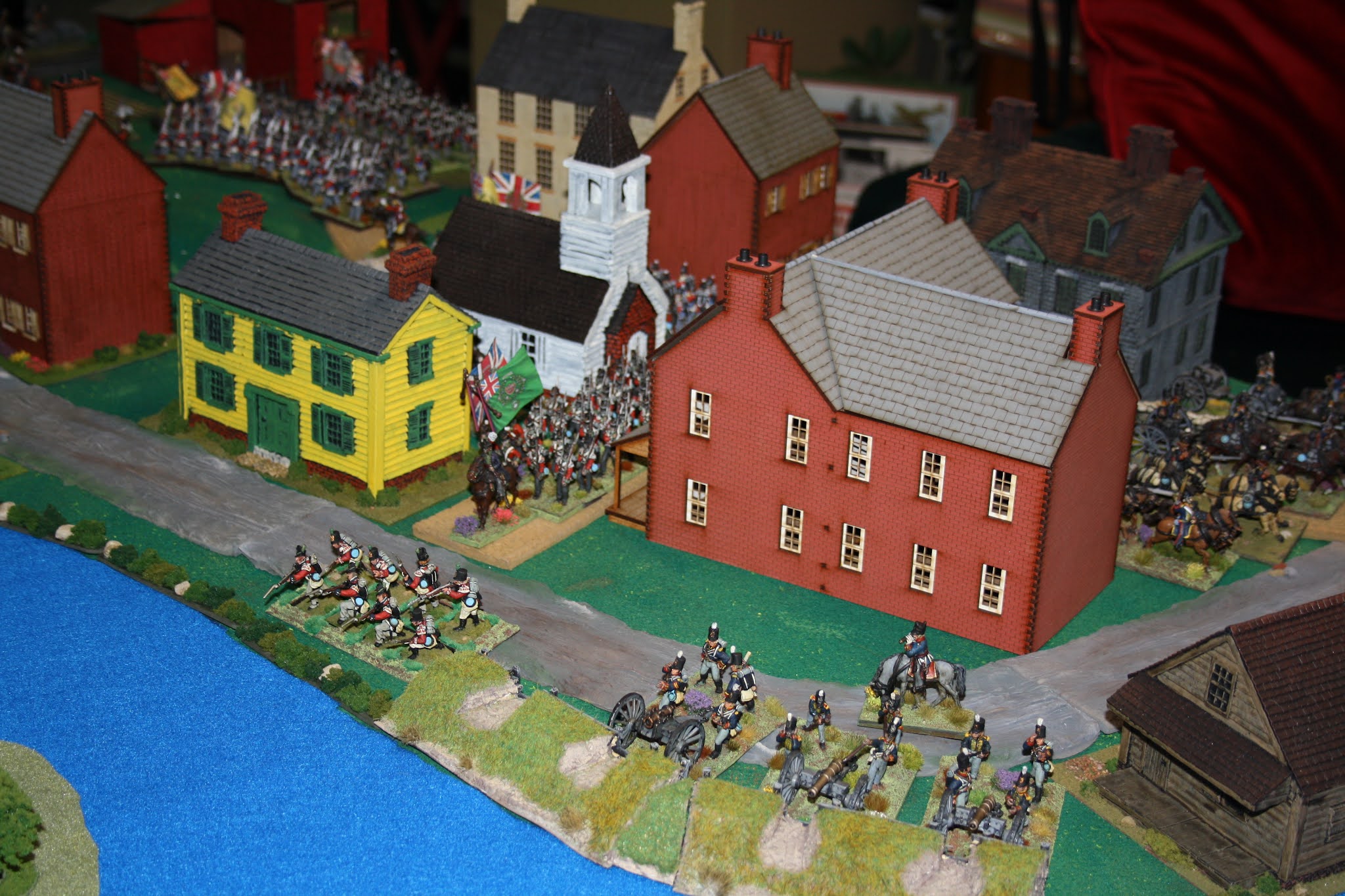
Game Start Situation. The Third brigades artillery battery engaging the Americans across the river on the peninsula.


Game Start Situation. The southern peninsula across the Saranac river from the town. The light artillery, U.S. Rifles, 29th Inf Light coy and Aikens rifles


Game Start Situation. Fort Brown on the left, Fort Scott on the right and Fort Moreau to the rear or right.


Game Start Situation. Farmer and is wife in the distance bringing the wheat. They are in for a surprise.

Game Start Situation. The remnants of the MGen. Moores NY. Brigade after a delaying action against the British onslaught.


Game Start Situation. The rocket battery and heavy 8" howitzer prepare to bombard the American forts.

Game Start Situation. The First brigade prepares to move out of the town.


Game Start Situation. British artillery eyes up the American light artillery across the Saranac River.


Game Start Situation. Battalions of the First brigade move past the aide station.

Game Start Situation. The British are in column of divisions heading down the road to the upper bridge.


Game Start Situation. A British 24pdr carronade is preparing to deal with some New York militia companies that are guarding the bridge.

Game Start Situation. It is pretty crowed in Fort Moreau. The 33rd and 34th Infantry wait behind the uncompleted wall of the fort next to the 18pdr field guns.


Game Start Situation. An unformed troop of the New York Dragoons militia cavalry guard the American flank at the Pike's Ford road.


Game Start Situation. The commander of the N.Y. Brigade previously were vainly delaying the onslaught of the British army down the Beekhampton road to Plattsburg. The N.Y. 9th regiment is in a retreat state south of the upper bridge and being rallied by Major-General Moores.
The Game Begins.
 The British divisional pioneers move up to repair the upper bridge supported by the 24pdr carronade and the light companies of the 27th and 76th regiments of Major-General Robinson's First Brigade.

After a successful third time roll as per the timetable, the advance guard of the Major-General Brisbane's Second Brigade with the Canadian Voltigeurs leading supported by the Mohawks arrives on the table.

MG Brisbane encouraging the Canadian Chasseurs to move quickly to the front along the Pike's Ford road.

While the 36/37th New York militia hold back the British Second brigade, the N.Y. Dragoons (right) vainly charge the British combined light companies.


The 36/37th New York militia manage to temporarily hold up the British juggernaut by charging the skirmishing Voltiguers who must evade. The N.Y. C.O. keeps a wary eye on the Mohawks off to his left.
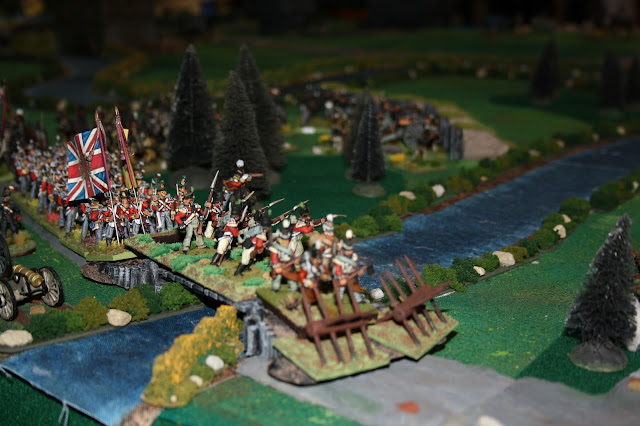
After four turns of rebuilding the upper bridge while under fire the advance elements of the First Brigade cross the upper bridge while the pioneers begin to remove the chevaux frieze blockage. Except for the Vermont Farnsworth Rifl, the N.Y. militia companies have been driven off the field.
 In the meantime the big guns of Fort Moreau that were constantly targeting the British Royal Marine rocket battery and heavy 8" howitzer in retaliation for several casualties.

Then Eric rolled snake eyes on the rocket firing table..."rockets double back and strike ammunition. Rocket battery completely destroyed. (Rout) "

Out on the Pike's Ford road the The 36/37th New York militia now have the Mohawks to the their rear. Things are not looking good for the New Yorkers. They are soon surrounded and must surrender.


With no N.Y. militia remaining the British Second Brigade Juggernaut keeps rolling down the Pike's Ford road.

The long red line starting to break out of the heavy wooded area with the Voltiguers screening the advance.


In the midst of the American Forts and British guns artillery duel, the Americans manage to roll a double six hit on a British column. As luck would have it, LtGen. Prevost was within 9 inches of the the targeted column and so the British player (Eric) had to roll on the Risk to General Table. He rolled a 3! So, LtGen. Prevost, "startled at near miss, gallops for safe cover and blunders into the enemy lines. Captured and presented to the enemy C in C." Some say there was a muffled cheer throughout the British First brigade.
 The valiant Vermont Farnworth's Rifles capture Prevost and escort him to BGen Macomb. MGen de Watteville is now in command of the British/Canadian army.


MGen. Moores rallies the the 9th N.Y. Regiment in the face of the British continuing advance.
The Situation at the end of Turn and gaming break for the day at around 17:30.

The 2nd Vermont Militia Regiment (Lucky reinforcement roll as per the Timetable) was not willing to wait for the rest of their division to gather at Salmon River. Instead, they proceed directly to the forts to support their regular brethren.

However, BGen Macomb intercepted them and ordered the Vermonters to head towards the Pike's Ford Road, which they duly did. Although some in the ranks complained that they were doing the real fighting while the regulars were sitting comfortable in their forts. As they climbed a hill covered in light woods this is what greeted them....

....the British Second brigade juggernaut swarming out of the heavy woods..

Good grief Mildred what is all that screeching and catawallering!

It is the Mohawks swarming into their farm fields.

The relentless Second Brigade trundles down the road.

The Voltigeurs lead by Major Harriot with the Canadian Chasseurs on their left and additional Voltigeurs skirmishing and screening in front spot the newly arrived Vermonters on the orchard hill top (mid upper).


Against impossible odds Farnsworth's Rifle company has been attrited to 50% and left the upper bridge road in the hands of the 27th/76th Light Companies and the following First Brigade. The Farnsworth's Rifle company has exceeded their duty by slowing the British advance. So far, they are a strong candidate for American Unit of Excellence of the game.


The heavy guns of Fort Moreau remain intact.

The guns of Fort Scott also remain intact.

In the northern peninsula area near the lake, the hot shot crew have been abandoned by the Light Artillery. What are they going to do do with that red hot shot?


In the northern peninsula area near the lake, the hot shot crew have been abandoned by the Light Artillery. What are they going to do do with that red hot shot?